
You CAN Meditate: A Beginner's Guide to Mindfulness
You've probably heard it before: "Just meditate." And maybe you've tried, only to find your mind racing, your to-do list louder than ever, and your patience gone within two minutes. So you quietly decided that meditation just isn't for you.
Here's the thing: that experience doesn't mean you failed at mindfulness. It actually means you encountered the most common misconception about what mindfulness is supposed to feel like.
What Mindfulness Actually Is (And Isn't)
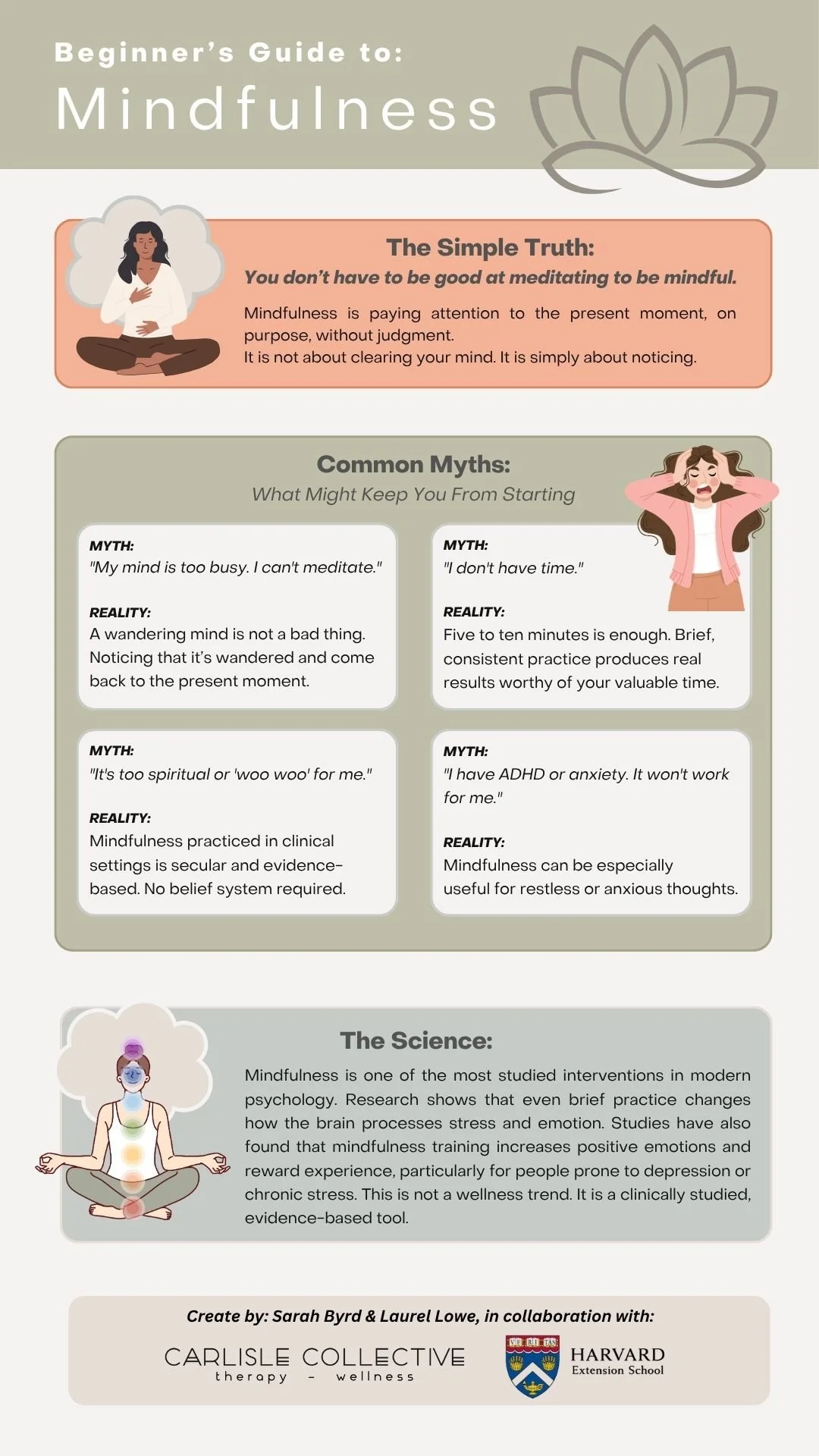
Mindfulness is the practice of paying attention to the present moment, on purpose, without judgment. That's it.
It is not about clearing your mind, achieving a blissful inner silence, or becoming a person who wakes up at 5am to sit cross-legged on a meditation cushion. It is about noticing your breath, the sensations in your body, the thoughts moving through your mind, and gently returning your attention when it drifts.
And it will drift. That's not a flaw in your practice; it is the practice.
This distinction matters, because the gap between what people expect mindfulness to feel like and what it actually involves is one of the biggest reasons people give up before they experience any benefit.
Common Misconceptions Worth Letting Go
"My mind won't stop. I can't meditate."
A busy, wandering mind is not an obstacle to mindfulness. It is the very reason mindfulness exists. The moment you notice your mind has wandered and choose to bring your attention back, you have done something genuinely valuable. That act of noticing, without self criticism, is the foundation of the entire practice.
"I don't have time."
The research on mindfulness does not require an hour-long daily commitment to show meaningful results. Brief, consistent practice, even five to ten minutes, has been shown to produce real shifts in how the brain processes stress and emotion. The barrier here is rarely time. It is usually the belief that a short practice doesn't count. In addition, because the benefits are often overlooked, mindfulness is often cognitively undervalued and unconsciously categorized as a poor priority over more stress-inducing priorities in the strive for efficient time management.
"Mindfulness is spiritual or religious, and it's not for me."
Mindfulness has roots in contemplative traditions, but the form practiced and studied in clinical and therapeutic settings is secular, evidence based, and increasingly standard in mental health care. You do not need to subscribe to any belief system to benefit from it. Many people who consider themselves skeptical of wellness trends find mindfulness accessible precisely because it asks nothing of you except attention.
"I have ADHD or anxiety. Sitting still is impossible for me."
This is one of the most important myths to address, because it keeps some of the people who could benefit the most from mindfulness from ever trying it. Mindfulness is not synonymous with sitting still and clearing your mind. Movement based practices, body scans, and short structured exercises are all valid forms of mindfulness that work especially well for restless or anxious minds. If traditional meditation hasn't worked for you in the past, it may simply be that the format wasn't the right fit.
The Benefits of a Regular Mindfulness Practice
When practiced consistently, mindfulness offers a meaningful range of mental and emotional health benefits that are well-documented in clinical research.
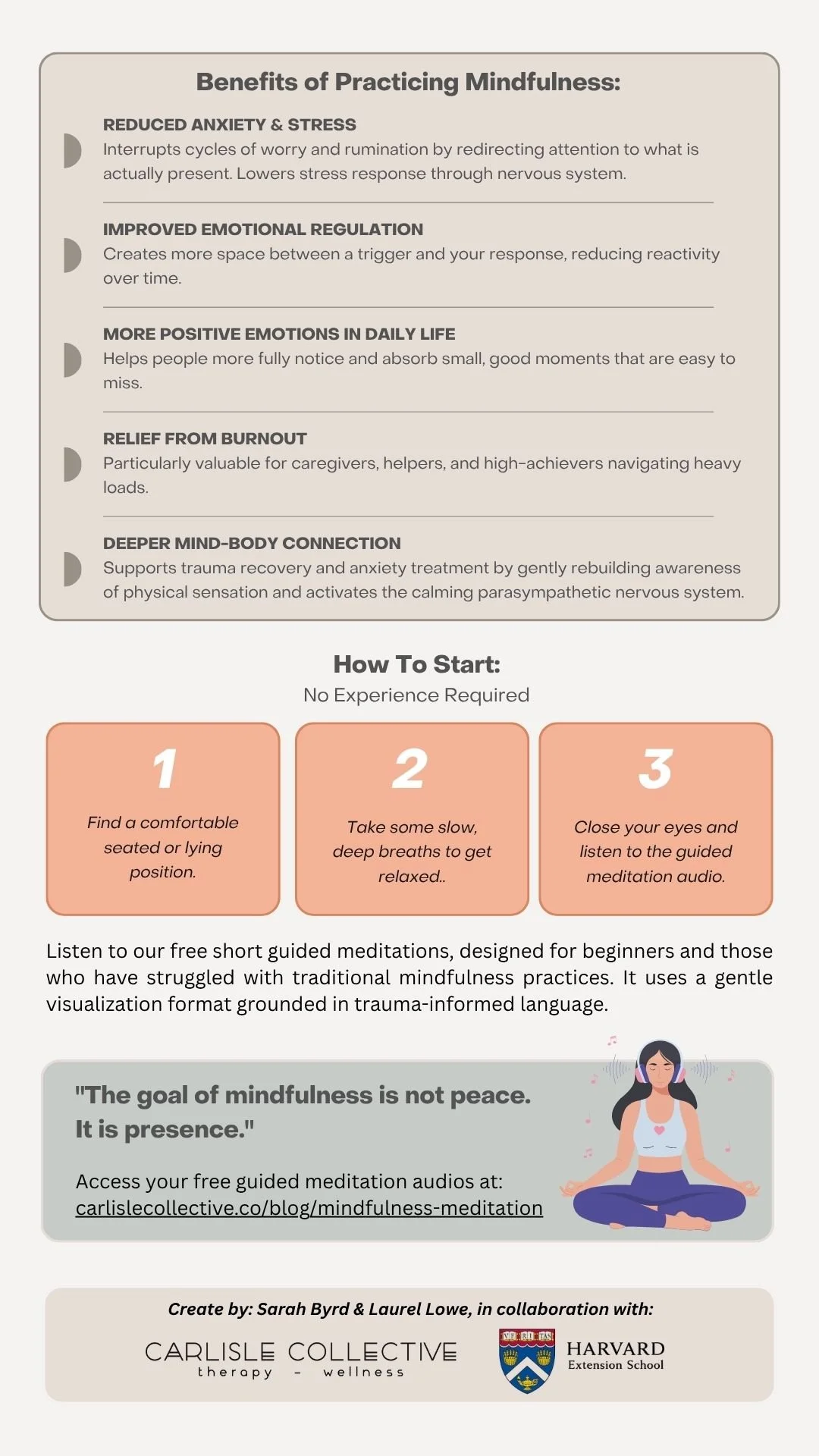
Anxiety and stress reduction are among the most widely studied outcomes. Mindfulness interrupts the cycle of worry and rumination by redirecting attention to what is actually present, rather than what the mind is anticipating or replaying. Over time, this rewires habitual stress responses and creates more space between a trigger and your reaction to it.
Mindfulness also supports emotional regulation, which is the ability to experience difficult emotions without being overwhelmed by them or acting impulsively. For people navigating anxiety, trauma, or high-pressure environments, this is often one of the most meaningful benefits they notice.
Research has also found that mindfulness increases positive emotions and the experience of reward in daily life. This doesn't mean it creates artificial positivity. It means that regular practice helps people more fully notice and absorb the small, good moments that are already present but easy to miss when the mind is elsewhere.
For those in caregiving roles, including therapists, healthcare workers, teachers, and parents, mindfulness has shown real benefits for reducing burnout and compassion fatigue. Supporting others requires an ability to stay present, and mindfulness is one of the most effective tools for building that capacity while also protecting your own wellbeing.
Finally, mindfulness supports a stronger mind-body connection, which is particularly valuable in the context of trauma recovery and anxiety treatment. Many people who carry stress or trauma in the body have learned to disconnect from physical sensation as a form of protection. Mindfulness-based approaches gently and safely rebuild that connection at a pace that feels manageable.
What the Research Says
Mindfulness is not a wellness trend or a vague self-help concept. It is one of the most studied interventions in modern psychology. Researchers have found that even brief mindfulness practice changes how the brain processes expected versus actual outcomes, which has real implications for anxiety, decision-making, and emotional resilience. Other studies have demonstrated that mindfulness training increases momentary positive emotions and reward experience, particularly for people who are vulnerable to depression or chronic stress.
These findings matter because they point to something concrete: mindfulness does not just make people feel calmer in the moment. It produces measurable changes in how the brain and nervous system function over time.
How to Get Started
The best way to begin a mindfulness practice is to remove as many barriers as possible. You do not need special equipment, a particular setting, or any prior experience. What helps most is a short, guided practice that tells you exactly what to do so you don't have to figure it out on your own.
We've created free guided audio meditations designed specifically for people who are new to mindfulness or who have tried it before and struggled.
The first one is a nine minute long guided journey utilizing box breathing and visualization intended to activate your calming parasympathetic nervous system and encourage positive self-affirmation, grounded in trauma-informed language. There is nothing to do perfectly. You simply press play, follow along, and notice what you notice.
The second one is a shorter five minute progressive muscle relaxation guided meditation that you can listen to when you’re feeling tense, stressed, or need to calm your body down. This will help you connect your body with any emotions that you feel are stuck, and help you release them.
To get started, find a comfortable position, either seated or lying down, put on headphones if you have them, and press play. That is the entire instruction.
A consistent mindfulness practice is built one session at a time. This is a good place to begin.
Sarah Byrd is a graduate of Naropa University, a Master’s-level Psychology student at Harvard University, and has a background in Contemplative Psychology and the neuroscience of Mindfulness.
Laurel Lowe is a graduate of University of Texas, a Master’s-level Psychology student at Harvard University, and has a background in substance abuse counseling and psychology.